
You waited weeks for that ring. Maybe months. And the moment it slides onto your finger, something feels off. A prong catches on your sweater the first time you reach for your coffee. The halo looks different in your kitchen lighting than it did in the jeweler’s showroom. The band sits heavier than you expected, or it won’t stop spinning.
You love the ring. You love the person who gave it to you. But there’s this tiny, nagging feeling you keep pushing down because you don’t want to seem ungrateful.
Here’s the thing: you’re not being picky. You’re noticing the details that separate a well-made ring from one that was rushed through production. And most people don’t learn the difference until they’ve been wearing their ring for months.
I asked Vanessa Nicole, a master diamond setter with over 20 years of experience creating custom engagement rings, to walk me through what she sees when she examines rings from other jewelers. Vanessa’s diamond dealers call her “Eagle Eye” because she catches flaws most people overlook entirely. What she shared changed the way I look at engagement rings.
“I point out things clients never would have thought to notice,” Vanessa says. “And once they see it, they can’t unsee it.”
So consider this your guide to seeing what most people miss.
Prongs That Snag, Scratch, and Look Uneven
Pick up any engagement ring and look at the prongs first. These tiny metal tips hold your diamond in place, and the quality difference between a rushed job and a skilled one shows up in every close-up photo once you know what to look for.
On mass-produced rings (and plenty of custom ones, too), prongs often look like round blobs of metal bent over the stone. One will sit wider than the next. Another has a slightly different shape. They’re uneven, and your eye goes straight to them instead of to the diamond.
Worse, many prongs sit too high above the stone. That’s what causes snagging on sweaters, scarves, and anything with fibers. If you’re a nurse, a teacher, someone who wears gloves for work, high bulky prongs turn your ring into a daily frustration.
Why does this happen? Casting produces raw prongs that stick straight up. A human hand bends them over the diamond and shapes them into their final form. The skill level of that hand determines whether you get blob prongs or sculpted ones. Mass production favors speed. Round blobs are the fastest shape to produce.
Vanessa takes a different approach. She sculpts her prongs to mirror the triangular facets of the diamond itself, creating thin claw shapes that flow with the stone rather than sitting on top of it. She uses a customized tool to make sure every prong measures the same width. The result: prongs so sleek your eye passes right over them and lands on the diamond, which is the whole point.
Before you commit to any ring, look at close-up photos of finished pieces from your jeweler. Not CAD renderings. Finished rings. If the prongs look uneven or bulky in photos, they’ll look the same on your finger.
The Halo Gap Nobody Warns You About
If you’re considering a halo engagement ring, this is the single most important detail to understand.
A halo should make your center diamond appear larger by surrounding it with smaller stones. Done well, it succeeds. Done poorly, it does the opposite, and the culprit is a visible gap between the center stone and the halo frame.
That gap creates a dark ring of empty space around your diamond. Instead of your eye reading one big sparkly surface, it reads a diamond floating inside a metal border. Dirt, lotion, and soap build up in that groove over time, making the gap more obvious as the months go on.
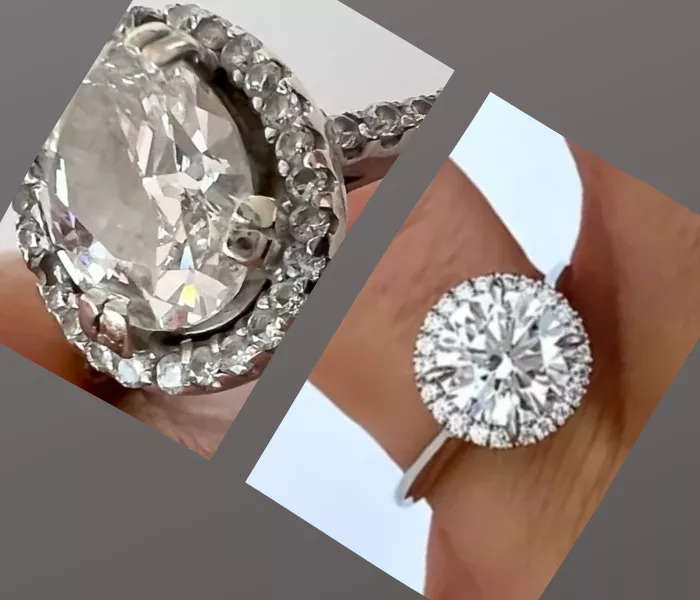
This happens because most jewelers don’t build their halo settings for one specific center stone. In mass manufacturing, the setting needs to accommodate a range of stone sizes. A universal fit means a universal gap.
In a seamless halo, the jeweler sizes and places each surrounding diamond to sit incredibly tight against the center stone. That changes the entire look of the ring. The diamonds practically touch. There’s no dark ring of space. All your eye sees is sparkle.
Ask your jeweler to show you close-ups of their halo rings from above and to the side. If you see a visible channel of metal between the center stone and the surrounding diamonds, that’s the gap. And once you notice it, you’ll see it on halo rings everywhere.
Diamond Spacing That Kills the Sparkle
Run your finger along the band of a ring with small diamonds set into it. On many rings, you’ll feel (and see) noticeable gaps between each stone.
Those dark gaps between the pavé diamonds on a band reduce the continuous sparkle effect and make the ring look less refined up close. The spacing might seem minor in a photo, but on your hand, in natural light, you notice it daily.
Why the gaps? Spacing diamonds further apart saves on materials. Pull one stone from each side of a band and multiply that savings by thousands of rings in a production run. It adds up fast for manufacturers. The customer rarely knows what they’re missing because they’ve never seen the alternative.
When diamonds sit close enough to nearly touch, the light bouncing between them creates an unbroken line of sparkle. Vanessa’s clients consistently tell her that their rings sparkle more than their friends’ rings. Tight diamond spacing, combined with color-matching the band diamonds to the center stone, is a big part of why.
Band Thickness and the Comfort You Didn’t Know to Ask About
The inside of your ring band matters more than you’d expect. Most mass-produced rings have flat or square-edged interiors because that shape is faster to polish. A comfort-fit band, rounded smooth on the inside, takes longer to refine. You feel the difference within an hour of wearing it.
Band thickness is the other hidden variable. A ring that’s too thin to save on metal weight feels flimsy and, over years of daily wear, will bend or crack at weak points. A proportional band, one that’s thick enough for the design without being bulky, holds up for decades.
Vanessa describes the difference as the gap between “that’s nice” and “now THAT is what I’m talking about.” You feel it the moment you slide the ring on. A proportional comfort-fit band sits on your finger like it belongs there. You stop noticing you’re wearing it, which is exactly the goal for something you’ll have on every single day.
Proportions That Make the Diamond Look Smaller
This one surprises people the most. A setting will make your center diamond look smaller than it is.
When the band is too wide relative to the stone, or the prongs are too thick, or the design adds too much visual weight around the diamond, the stone appears to shrink. A visual trick works against you. Instead of framing the diamond, the setting competes with it.
This tends to happen when you select a diamond separately and drop it into a pre-made setting. Nobody designed the proportions for that specific stone. A 1.5 carat oval in a setting originally built for a 2 carat round is going to look off, even if you can’t immediately explain why.
Designing the ring around the specific diamond solves this, so every element (band width, prong size, halo scale, profile height) serves the stone rather than fighting it.
What to Ask Before You Commit
You don’t need to become a jeweler to protect yourself. A few specific questions will tell you a lot about the quality you’re getting:
- “Can I see close-up photos of finished rings, not renderings?” A CAD rendering shows intent. A finished ring shows skill. Any jeweler proud of their work will have these photos ready.
- “How are the prongs shaped after casting?” If the answer involves hand-sculpting and quality checks, that’s a good sign. If the answer is vague, pay attention to what’s not being said.
- “Is the setting built for my specific center stone?” This question matters for halo rings especially. A setting designed for your exact diamond will fit differently than one pulled from a catalog.
- “What’s the band thickness, and is it comfort-fit?” A jeweler who pays as much attention to the inside of the band as the outside is thinking about how you’ll live with this piece for the next fifty years.
- “Will the band diamonds be color-matched to the center stone?” Mismatched diamond color is one of the most visible quality shortcuts, particularly on halo rings where the center stone and surrounding stones sit right next to each other.
A jeweler who welcomes these questions is someone worth your trust. One who brushes them off is telling you something important.
The Moments That Happen When the Details Are Right
When every detail lines up, you feel it. Vanessa shared a story about a client whose photographer stopped the wedding to ask if she could try on the ring. Another client’s husband catches her staring at her ring constantly and teases her about it. One bride put it this way: “I got myself a magnifying glass to make sure there were prongs in there, but it’s so beautiful. It sparkles all the time. It doesn’t stop.”
Those moments don’t happen by accident. They happen because someone paid attention to prong shape, diamond spacing, halo fit, band comfort, and proportional design. All the details most people never think to ask about.
The ring you’ll wear every day for the rest of your life deserves that kind of attention. Now you know what to look for.
To see behind-the-scenes videos of how these details come together in a finished ring, visit Vanessa Nicole Jewels.
This is a guest post.