

You love your rose gold engagement ring. Then you try on a white gold wedding band and love that, too. Do you really have to put it back because the colors don’t match?
No. Rose gold and white gold can look lovely together. The choice is partly about the contrast you enjoy and partly about how the two particular rings sit together. A pair can look beautiful from above and still need a closer check at the sides.
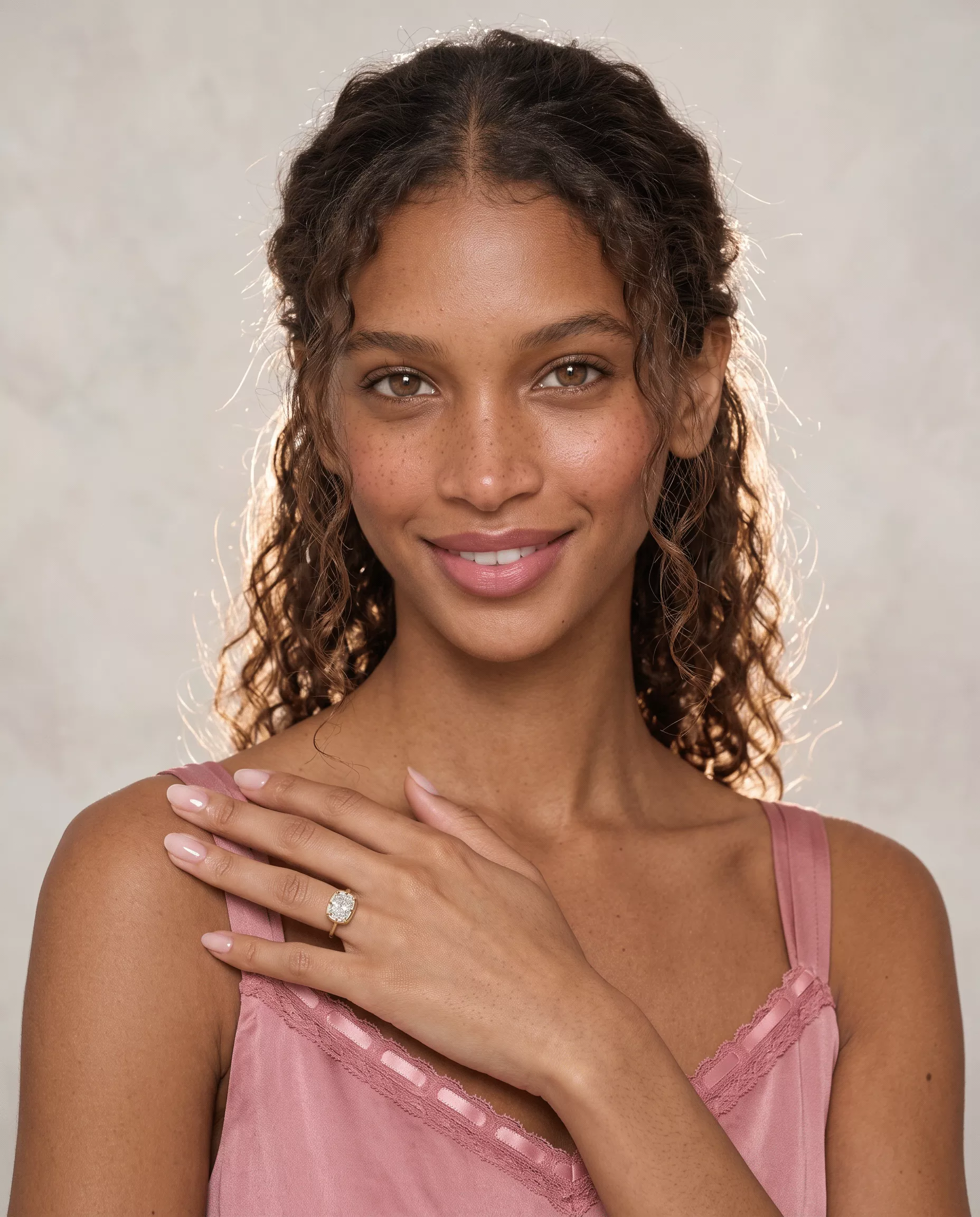
Choose how much contrast you want
A plain white band beside plain rose gold creates two distinct lines of color. A diamond-set wedding band brings more sparkle into the picture, so the contrast between the metals may feel less pronounced.
The engagement ring matters too. Lily Arkwright’s rose gold engagement rings include the plain-band Grace solitaire and the diamond-set Lillie Luxe. Both are available with round lab-grown diamonds, but their bands leave different amounts of rose gold visible. When viewed from above, a diamond-set band may show rose gold mainly around the small stones, rather than as an uninterrupted pink line.
If you like the two-color effect, try a plain white band first. If you want the pair to feel more closely connected, repeat a detail, such as small round diamonds or a similar band width. You don’t need to add a third ring simply to make the colors belong together.
White gold and platinum are different choices
“Silver-colored” describes a look, not the metal itself. Check whether the band is white gold, platinum or sterling silver before deciding it is the right companion for your ring.
White gold is an alloy of gold and other metals. As GIA’s guide to white metals explains, it is often rhodium-plated for a bright white surface, and that plating can wear and need renewing. Platinum has a naturally white color and does not depend on rhodium plating to achieve it.
For a white gold band, ask whether it is plated and what future replating involves. Compare it beside your engagement ring in the same light. Two separate product photographs can make their colors seem closer, or further apart, than they are in person.
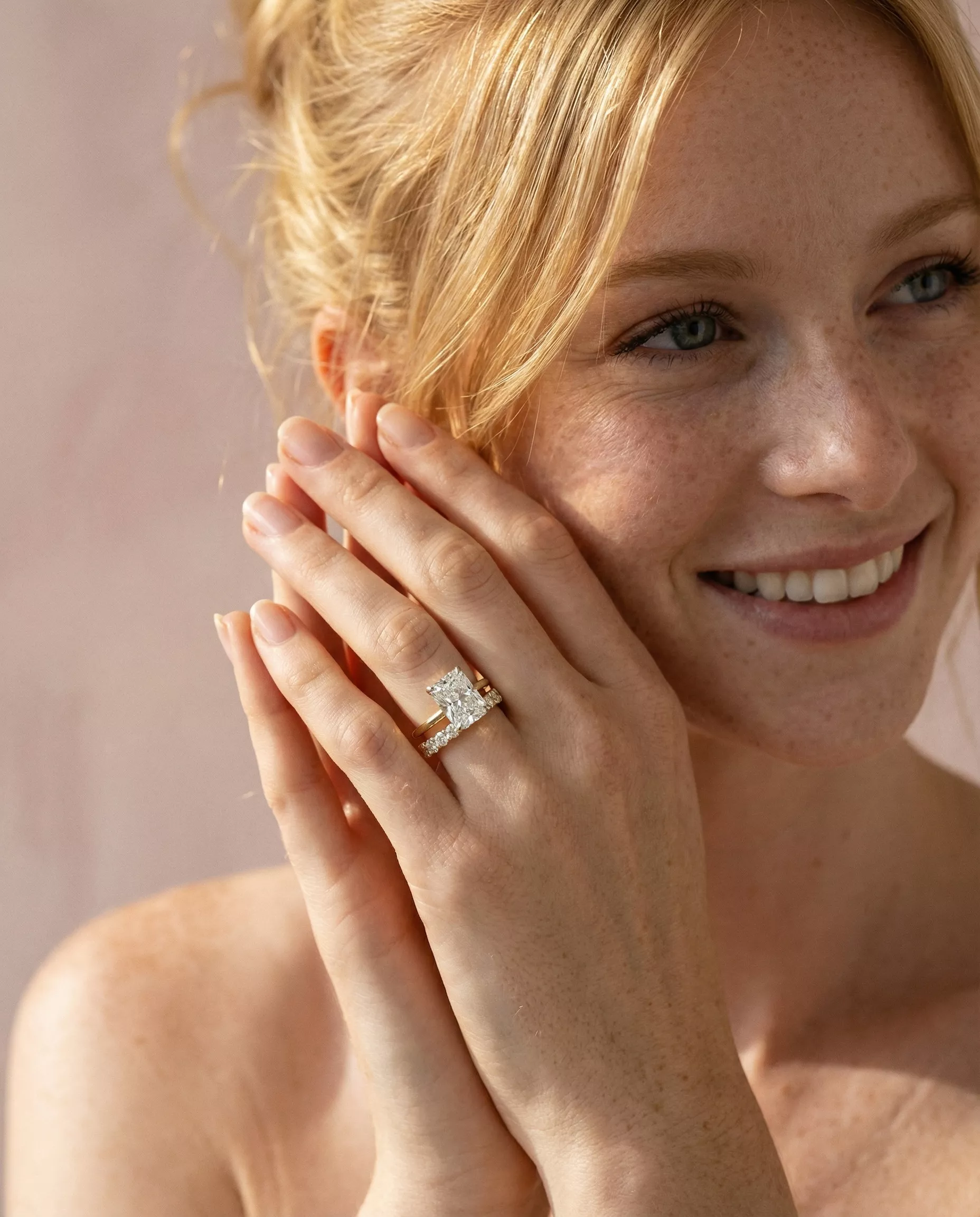
Check where the rings meet
Even if you love the colors together, the rings still need to sit comfortably side by side. A wedding band may slide neatly beneath the engagement ring’s center setting, leave a gap, or press against part of the setting.
Bring your engagement ring when trying bands and ask the jeweler to look at the contact points. Pay attention to any small diamonds or prongs along the sides, rather than checking only whether the bands line up from above. Matching the metal color won’t fix an awkward fit.
GIA’s ring-stacking guidance warns that rings worn together can scratch and wear against one another, particularly when different metals are involved. Ask about the actual alloys and construction of your pair, rather than assuming every mixed-metal pair behaves alike.
If a straight band presses against the setting, curved and open wedding bands offer other shapes to explore. A small gap can also be part of a pair you enjoy wearing. The jeweler can help you find a comfortable arrangement with enough space around the setting.
Try the pair, then wear the wedding band alone
Two rings can feel more snug than either one by itself. Have the fit assessed while wearing both, especially if you are considering a wider wedding band. Buying it in your engagement-ring size without trying the combination may miss that difference.
Keep the pair on for a few minutes. Bend your fingers and notice whether the bands feel crowded or uncomfortable. Then remove the engagement ring and look at the wedding band on its own.
That last step is easy to skip when you are concentrating on finding a match. A curved band will have a different outline alone, while a broader plain band may become the main feature. If you expect to wear your wedding ring by itself sometimes, make sure you like that version too.
You may end up choosing white gold because it echoes a piece of jewelry you already love, or simply because the contrast makes you smile. Once the fit and contact points have been checked, the rings do not need to be the same color to feel like your pair.
This is a sponsored post with LilyArkwright.