
Remember the old advice? Spend three months’ salary, buy the biggest round diamond you can afford, and don’t ask questions. Most couples have quietly stopped following it. Couples who married in 2025 spent an average of $4,600 on the ring, down from $5,200 the year before, according to The Knot’s 2026 Real Weddings Study. And 61% of them chose a lab-grown center stone.
That’s a big change in a short time, and it means the rulebook your parents used doesn’t fit anymore. The good news is that you have more freedom than any generation before you. The tricky part is knowing where to spend and where to save. Here’s a practical, no-pressure way to pick a ring she’ll actually love wearing every single day.
Start With Her Life, Not the Trend Board
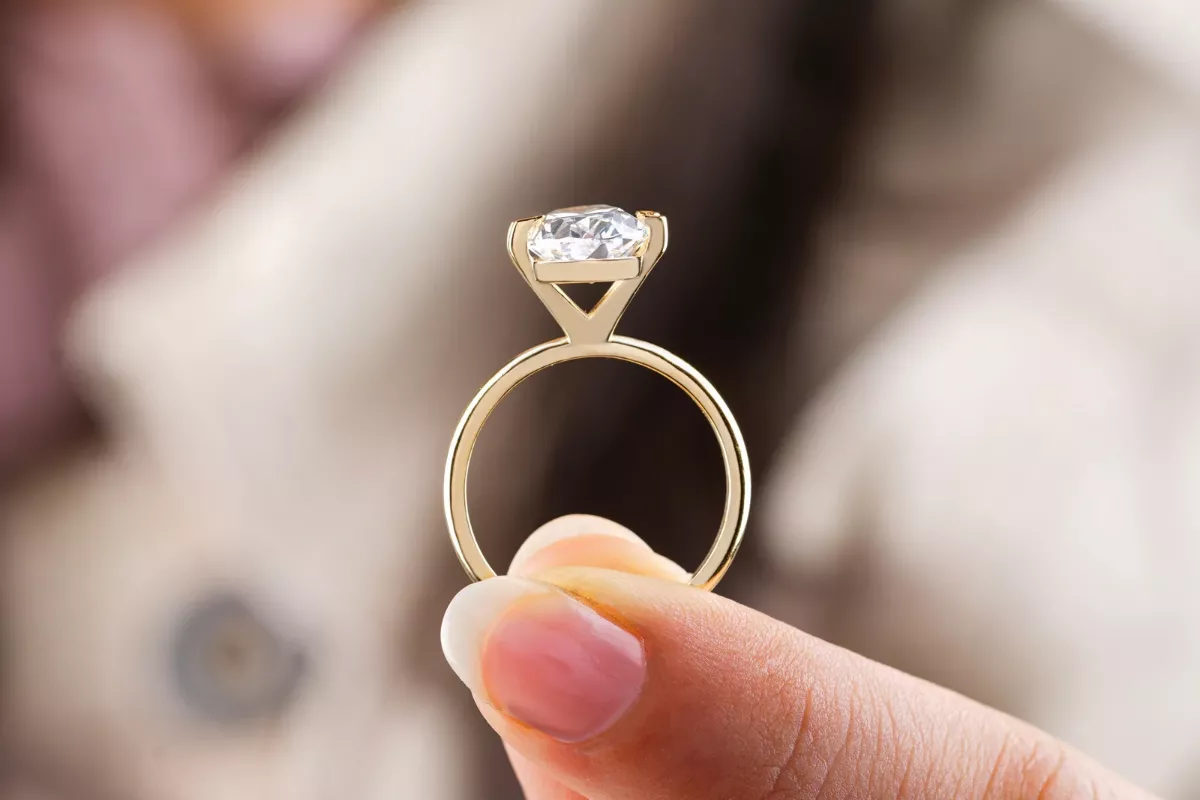
Before you look at a single stone, think about how she lives. A nurse who washes her hands forty times a shift, a climber, a potter and a graphic designer who types all day will each need something different. A tall, pointy setting that looks gorgeous in a photo snags on sweaters, hair and gloves.
So pay attention. When she starts browsing engagement rings, notice whether she saves low-set, snag-free settings or dramatic halos. Check what she already wears: yellow or white metal, delicate chains or chunky cuffs.
If she’s the type to skip the traditional route altogether, our roundup of non-traditional engagement ring ideas covers colored stones, mixed metals and one-of-a-kind designs. Her best friend or sister is also a great spy. Ask them what she’s said, and look at what she pins or screenshots.
Set a Budget That Matches Real Life
The three-month-salary rule was a marketing line, not a financial plan. Today’s numbers are far more modest. Rapaport’s coverage of The Knot’s 2026 study reports the $4,600 average for 2025 rings, a fall from $5,200 the previous year. That makes four straight years of couples spending less.
My advice: pick a number you can pay without borrowing, then stick to it. A ring that starts your marriage with high-interest debt isn’t a good deal, however sparkly it is. You’ll also want cash left for the wedding itself, and for the bands.
If your budget is tight, don’t panic. Plenty of gorgeous options exist for less, and our list of ring styles under $1,000 proves that a modest price tag doesn’t have to look modest. Moissanite and sapphire are popular alternatives, and the same Rapaport report notes they were the most common non-diamond center stones.
Lab-Grown vs. Natural: What the Numbers Say
Here’s where the shift is most obvious. The Knot Worldwide’s 2026 study found that lab-grown stones account for 61% of engagement ring purchases, a 239% increase since 2020. The price gap explains much of it. According to Rapaport’s summary of the same research, the average natural-diamond ring cost about $7,000 for 1.6 carats, while the average lab-grown ring cost about $4,300 for 2.0 carats.
Lab-grown diamonds have the same chemical makeup and sparkle as mined ones; the difference is where they came from. My take: if you’re budget-first, lab-grown is the smart default. You get a bigger, cleaner stone for less money. Natural makes sense if origin matters to you emotionally, or if you want a stone with a traditional story. Just don’t buy natural expecting a big resale payout, because diamonds rarely return what you paid.
One tip: whichever you choose, make sure the seller is upfront. The FTC says that lab-grown disclosures should appear right next to the product description, not buried in fine print. If a listing is vague, move on.
Curious which lab-grown styles are worth a look? Our guide to the best lab-grown diamond rings is a good starting point.
Prioritize Cut, Then Shape and Setting
Most shoppers fixate on carat weight. That’s backwards. The GIA’s diamond quality guide lays out the 4Cs (cut, color, clarity and carat), and cut is the one that controls how much light a stone returns. A well-cut smaller diamond will outshine a sloppy larger one every time. Spend there first, then trade down on color or clarity, where many differences are invisible without magnification.
Shape matters too. According to Rapaport’s coverage of The Knot’s latest data, round is still the most common shape at 26% of rings, but ovals are close behind at 25% and lead among lab-grown buyers. An oval tends to look larger than a round stone of the same carat weight, since its elongated outline shows more surface from above. It also flatters shorter fingers.
Then think about metal. Platinum is durable but costs more. White gold needs periodic re-plating to keep its bright finish. Yellow gold is warm, forgiving and hugely popular right now. And whichever you pick, a low-set bezel or a basket setting is the practical choice for someone who works with her hands.
Final Checks Before You Buy
You’ve picked a style and a stone. Before you pay, run through a few last checks:
- Ask for a grading report from an independent lab such as GIA or IGI.
- Read the return and resizing policy; you want at least 30 days.
- Get the ring insured as soon as you own it.
- Borrow one of her rings to find her size. A resize later is cheap and easy.
- See the stone in person, or ask for a video in natural light.
Don’t forget the person at the other end of this. The best ring isn’t the one with the highest specs or the biggest price tag; it’s the one she reaches for every morning and never wants to take off. Start with her life, choose a budget you can live with, and let the rest follow.
This is a partnered post.