
Stacking a wedding band alongside a round brilliant solitaire is very straightforward. If stacking a wedding band alongside a kite-cut moss agate, a pear-shaped Montana sapphire, or an east-west set oval is a whole different story. The classic straight band that is a perfect match to a traditional ring often gets an awkward pose, leaves a gap large enough for a vehicle, or looks like it has no visual connection at all to the engagement ring.
If the reason for a non-traditional engagement ring was that you wanted something that stands out, you already know that the wedding band decision is more difficult than the bridal pieces imply. Most of those pieces assume that you have a standard round center stone with a symmetrical setting and their advice is no good the moment your ring doesn’t fit that assumption.
If your engagement ring was the one with character, here is the right way to get through stacking.
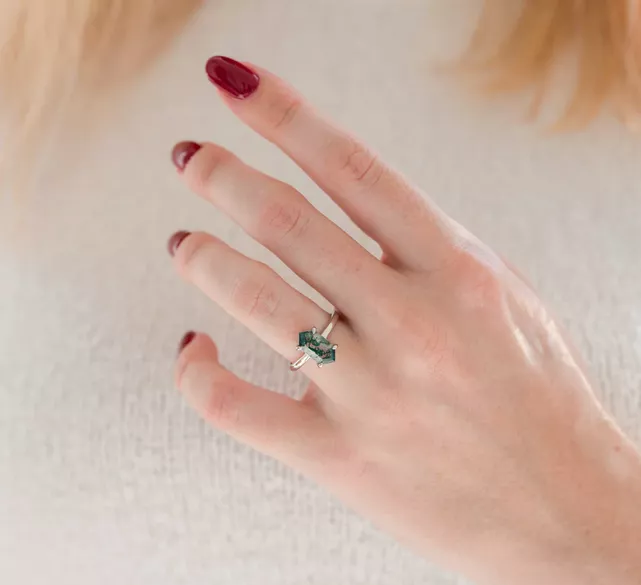
Start by Looking at What Your Engagement Ring Actually Does on Your Finger
Hold your engagement ring and place it on your hand. What does the center stone look like? Is it raised very high or positioned very low? What about the sides of the setting, do they spread out or stay close to the band? Does the shank get thinner the closer it gets to the stone, or does it keep the same width all the way through?
Such intricacies define what is actually achievable from the physical point of view. In fact, a ring which has a setting that is very high and a shank that is of the low profile can effortlessly have a band that is flushed slid up right against it. On the other hand, a ring that has a thick gallery, side stones or a wide halo stands as a physical barrier that prevents a straight band from being placed really close to it – and it is this gap that results in stacked rings looking not only inappropriate but as if they have been placed by accident.
Make sure to also observe which direction your center stone is facing. An oval or marquise laid east-west points across your finger instead of along it, which totally alters the kind of band shapes that will go together. A kite cut has four points, and each one sets up its own visual block. Getting to know the physical shape of your ring will serve you better than staring at Pinterest ideas.
Contoured and Curved Bands Are Almost Always the Answer
Pretty much any engagement ring with an unusual or asymmetrical shape will be complemented most beautifully by a contoured wedding band – one which has been shaped to fit the particular curve of your engagement ring – way better than a straight band, in my opinion. The contour not only removes the gap, but also embraces the form of the center stone, and as a result, the two rings appear as a designed pair rather than two separate pieces that coincidentally have come to the same finger.
If you have a pear-shaped engagement ring, a band featuring a gentle V-shape or curved point is aligned perfectly with the pointed end of the stone. Marquise cuts go well with a double-curve band which complements both points. Oval rings are nicely matched with softly curved contoured bands, whereas cushion cuts generally get their most flattering look from subtle wave bands that recall the softly rounded corners of the stone.
Kite and hexagon cuts are the trickiest. Their angular shapes rarely work with off-the-shelf contoured bands from mass-market bridal retailers, which is why custom-made options have become the default for brides with these geometric stones. This is where handmade rings really come into their own – smaller jewelers who cut and set each piece individually can actually match a band to the specific angles of your kite or hexagon, something machine-produced inventory simply can’t do.
If a truly custom band isn’t in your budget, look for bands labeled as “shadow bands,” “fitted bands,” or “enhancer bands.” These are pre-made contoured options designed specifically to sit flush against non-traditional engagement ring shapes.
The Stack Doesn’t Have to Be Flush
Here’s the liberating secret most brides are not aware of your wedding band doesn’t necessarily have to touch your engagement ring physically. The idea of flush-stacked bands is quite a new trend, and many brides are wearing their wedding band on a different finger, or even leaving a space between the two rings on the same finger deliberately.
The open stack, where the two rings have a small gap between them by design, is actually one of the best ways to go for quite elaborate engagement rings. A ring featuring leaf carvings in the design of nature, a vintage one with filigree, or a halo surrounded by many small stones are already quite busy visually, so bringing in a second ring right up against the first one just creates excess. The little opening allows each ring to have its own space.
Some brides take this even further and wear their wedding ring on the other hand, or on a different finger of the same hand. This is mostly when the engagement ring is so unique – a rough moss agate, Herkimer diamond with raw crystal faces, a particular collection piece – that you wouldn’t be able to find a wedding band to complement it without there being some competition between them. Wearing them separately is a way for each ring to have its moment.
Matching Metals, Colors, and Details
The fastest way to make a stacked pair of rings look like an accident is to mix metals in a very careless manner. If your engagement ring is made of yellow gold and your wedding band, white gold, that is a very hard combination to carry through the rest of your jewelry – with a third ring in rose gold you can make a clear mixed-metal statement, rather than appear as if you just grabbed the band that was available.
In case you are not aiming for the mixed-metal look, then you should exactly match the metal of your engagement ring. 14K yellow gold should stack up against 14K yellow gold. 18K rose gold should stack up against 18K rose gold. At first glance, platinum and white gold seem to be similar, but when you place them next to each other their different undertones become obvious.
When it comes to colored gemstone engagement rings, you should think twice about adding more color through your wedding band. Combining a sapphire center stone with a diamond band is a classic and harmonious option. A sapphire center stone and a sapphire band can look wonderful, but only if the shades of blue are perfectly matched – mismatched blues will look like you couldn’t decide. Solid metal bands almost always work with colored gemstone engagement rings as they give the center stone a chance to be the star.
Practical Considerations Most Brides Don’t Think About
Comfort is a very important factor when stacking wedding bands. Two rings side by side will fit tighter than one ring, so some brides have their engagement ring resized or sized up so that the stacked pair is comfortable. If you plan to size before your wedding band is made, make sure to discuss this with your jeweler.
It is also possible to solder the two rings together after the wedding, which is what some brides do, especially if the rings do not naturally fit perfectly together. Soldered rings no longer rotate against each other, they cannot have awkward gaps, and they act like a single unit. The only disadvantage is that you lose the freedom to wear them separately, and also resizing is quite complicated.
Keep in mind the activities you do everyday. If you type a lot, a wedding band that has raised details on the top will always hit your laptop. If you are working with your hands, it is logical to have your wedding band a completely flush one. On the other hand, if you often wear gloves, you can be surprised at how fast the sharp edges of a geometrically shaped band can wear through glove fingers.
This is a guest post.