
Nobody warns you about the listing.
The proposal itself? You’ve probably imagined that a hundred times. But the part where you’re squinting at product pages at midnight, trying to figure out whether “VS2 clarity” is good enough or whether the diamond in that photo actually looks like that in real life — that part sneaks up on you.
Here’s the thing: a ring listing isn’t just a description. It’s a document you need to read carefully, because the details buried in it will determine whether you’re thrilled with the ring six months from now or quietly wondering what you missed.
Let’s go through what actually matters.
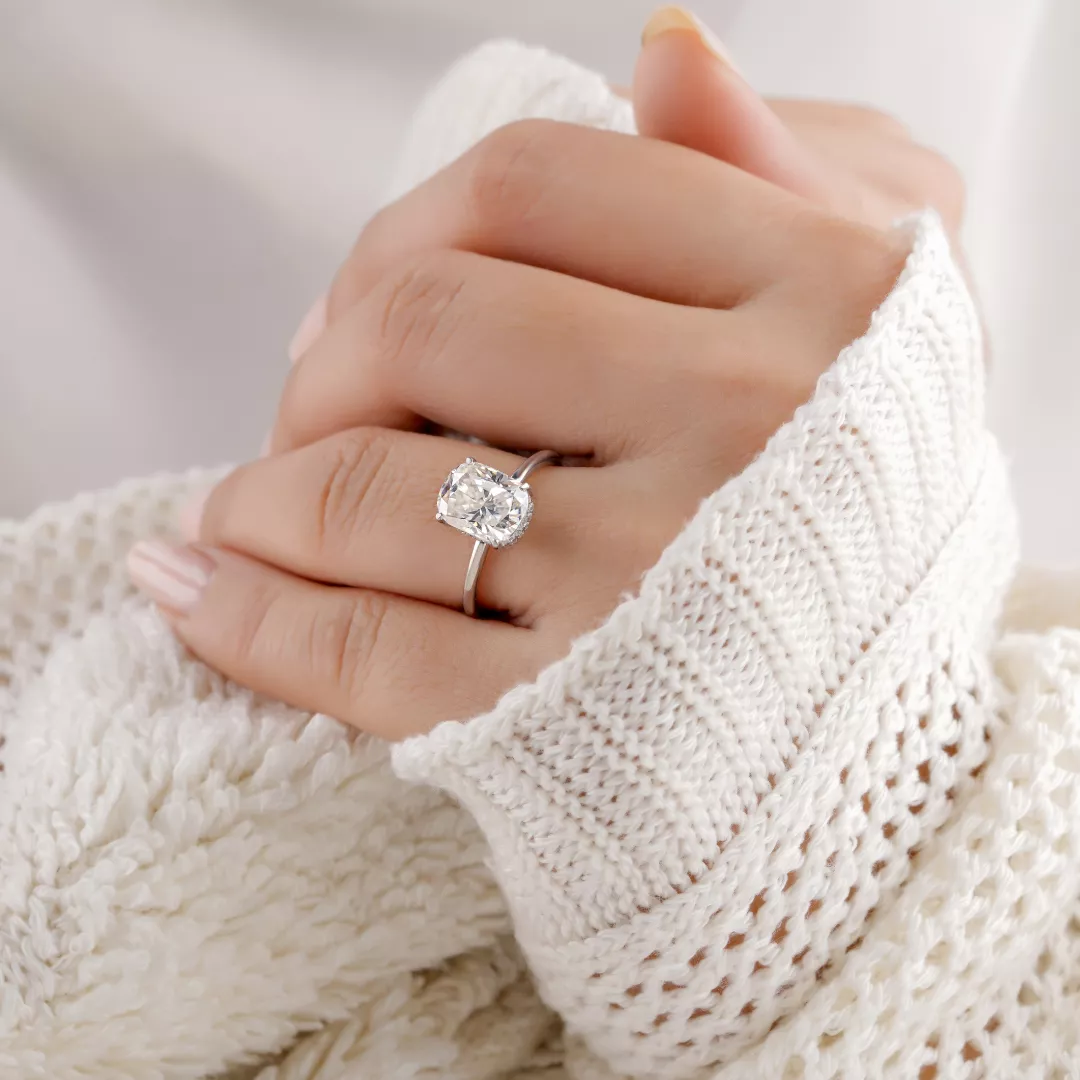 photo: the glorious studio via pexels
“Diamond Ring” Doesn’t Always Mean What You Think
The very first word before “diamond” in a listing is doing a lot of work.
Lab-grown and natural diamonds are both real diamonds — same chemical makeup, same optical properties, same hardness. The GIA is clear on this. The difference is origin: one formed over billions of years underground, the other was created in a lab using advanced technology. Neither is fake. But they’re not the same thing, and they don’t carry the same price, resale value, or emotional weight for everyone.
The FTC requires sellers to use specific terms, such as “laboratory-grown” or “laboratory-created,” when that’s what they’re selling. The problem is, not every listing makes this obvious. Sometimes the origin is mentioned in a headline. Sometimes it’s in a bullet point near the bottom, after three paragraphs about the setting.
If you and your partner haven’t talked about which you prefer, it’s worth having that conversation before you buy. Some couples love lab-grown because it means a significantly larger stone for the same budget. Others want natural because of what it represents — rarity, tradition, something that came from the earth. There’s no wrong answer. But there is a wrong outcome: buying the wrong one because the listing was vague.
If the title says “diamond engagement ring” but you have to hunt for the word “lab-grown,” slow down and ask.
Carat Is Weight. Not Size. Not Sparkle. Weight.
This is the misconception that catches the most people off guard.
A carat is a unit of weight — one-fifth of a gram, according to the FTC. It does not tell you how large the diamond will look on a finger. Two diamonds can weigh exactly the same and look noticeably different in a ring box or on a hand, depending on how they’re cut and shaped.
An oval or marquise diamond, for example, tends to look larger across the finger than a round diamond of equal carat weight. That’s not an illusion — it’s geometry. The stone covers more surface area. On the other hand, a diamond cut too deep hides weight in the base you can’t see, which means you’re paying for carat weight that’s not contributing to the look you actually want.
Lab-grown diamonds make higher carat weights more financially accessible, which is genuinely great. But don’t let a bigger number on a listing replace the question you actually need to ask: does this diamond look beautiful in this setting, in this shape, on this kind of hand?
All Those Decimals Feel More Precise Than They Are
Engagement ring listings love numbers. You’ll see things like 1.03 ct, 6.42 mm, 61.5% depth, 57% table. It looks impressively specific.
Some of it is genuinely useful for comparing stones. But the FTC notes that when carat weight is listed as a decimal, it’s accurate only when rounded to the last decimal place — meaning a .30 carat diamond could fall within a small range around that figure. A listing with more decimal places doesn’t necessarily mean a more precise stone.
This matters when you’re comparing several rings and start feeling like a 0.02 carat difference is a dealbreaker. It probably isn’t. The setting, the cut quality, the grading report, the return policy, and honestly how the ring actually photographs on a real hand — those things will affect your satisfaction far more than a barely perceptible numerical gap.
If you want to understand how precise a number actually is before letting one decimal point steer a major purchase, it’s worth a look before you get too deep into comparison mode.
The Grading Report Is Not a Formality
A reputable engagement ring listing will reference a grading report from a recognized gemological lab. This is your verification that what’s described in the listing is actually what’s in the box.
Don’t just note that a report exists, actually check it. If the listing gives you a report number, look it up. Confirm the carat weight, shape, color, clarity, and origin match what the seller is claiming. For lab-grown diamonds especially, make sure the listing isn’t quietly blurring the line between a lab-grown diamond and a simulant like cubic zirconia or moissanite. Simulants can be lovely, but they are not diamonds. If your partner expects a diamond, that distinction is not a small one.
This is the step most people skip because they’ve already fallen for the ring in the photos. Don’t skip it.
The Band Will Determine Whether the Ring Gets Worn Every Day
The center stone is what you’ll photograph, but the band is what your partner will feel every single morning when they put the ring on.
Ring sizing is more complicated than most people realize. Finger size shifts with temperature, time of day, exercise, hydration, and even sodium intake from the previous night. A ring that fits perfectly during a warm summer proposal might feel different in January. And a wide band — common with many modern engagement ring designs — will naturally feel snugger than a narrow one in the same listed size.
Ring sizing is based on the circumference of the finger, and if you want to understand what the size charts are actually measuring, looking at how finger circumference translates to ring size can make those charts a lot less confusing. That said, treat any home measurement as a starting point, not a final answer. If the ring is expensive, hard to resize, or custom-made, get a professional fitting.
Lab-Grown vs. Natural Is One Question, Not the Only Question
The lab-grown vs. natural debate has gotten a lot of attention, and it deserves some — but it can also crowd out equally important decisions.
A proposal ring needs to work for the person who’s actually going to wear it. Someone who uses their hands constantly at work may be much happier with a low-profile setting than a dramatic elevated solitaire. Someone with a deep love for vintage jewelry may care more about the design details than the carat number. Someone already thinking about a wedding band needs to consider whether the engagement ring setting will even allow a band to sit flush against it.
So yes, compare lab-grown and natural diamonds. Read the origin disclosures carefully. Understand what carat weight is and isn’t telling you. Verify the grading report. Look at the actual millimeter measurements. Think about the band.
Then choose the ring that’s honest about what it is, beautiful to the person who’ll wear it, and right for the moment you’re building toward.
The listing is just the start. The ring is the thing.
This is a partnered post.