

When you start planning a wedding reception, it is easy to focus on the tables first: centerpieces, candles, flowers, linens. Then you step back and notice the blank wall behind the sweetheart table or the empty corner where guests are supposed to take photos.
That is usually where a backdrop comes in.
A good backdrop does not have to be the biggest or most elaborate part of the room. It just needs to make an important area feel finished and intentional. The trick is choosing one that works with the space you already have rather than planning the whole reception around one decorative piece. In this post, we’ll share ideas for how to style backdrops at your wedding reception so they look picture-perfect.
Start With the Spot You Actually Want to Highlight
Before choosing a color or design, decide what the backdrop is meant to frame.
For many receptions, that is the sweetheart table. It is where the couple sits during dinner, where plenty of photos are taken, and often where speeches happen nearby.
But it is not the only option. A backdrop can also work well behind a cake or dessert table, a guest photo area, a welcome display, the reception entrance, or a small lounge.
Each space needs something a little different. A wide setup can make sense behind a sweetheart table or group photo area, while an arch may be all you need behind a cake table or welcome sign.
If you are still figuring out what will work in your venue, looking through different wedding reception backdrops can help you compare full-width designs, arches, and freestanding setups before you commit to one direction.
Start with the location first. The rest of the styling becomes much easier from there.
Look at the Room Before You Look at the Wedding Colors
Of course the backdrop should work with your color palette, but that is only part of the decision.
Take a good look at the venue itself. Is the wall already decorative? Is there molding, brick, wood, large windows, or architecture you may want to keep visible?
A detailed ballroom usually does not need the same kind of backdrop as a plain event hall. If the room already has a lot going on, something simple may be the better choice. If you are working with a large blank wall, you have more room to use a stronger print, shape, or decorative setup.
Also remember that the backdrop will not be standing there by itself. Flowers, candles, chairs, signs, tables, and the people in front of it will all become part of the final look.
Something that seems almost too simple on its own may feel just right once the rest of the decor is in place.
Choose a Shape That Makes Sense for the Setup
A full-width backdrop works especially well behind a sweetheart or head table because it creates a complete background behind both the couple and the table decor. It is also useful for guest photos, especially if you expect groups rather than just one or two people.
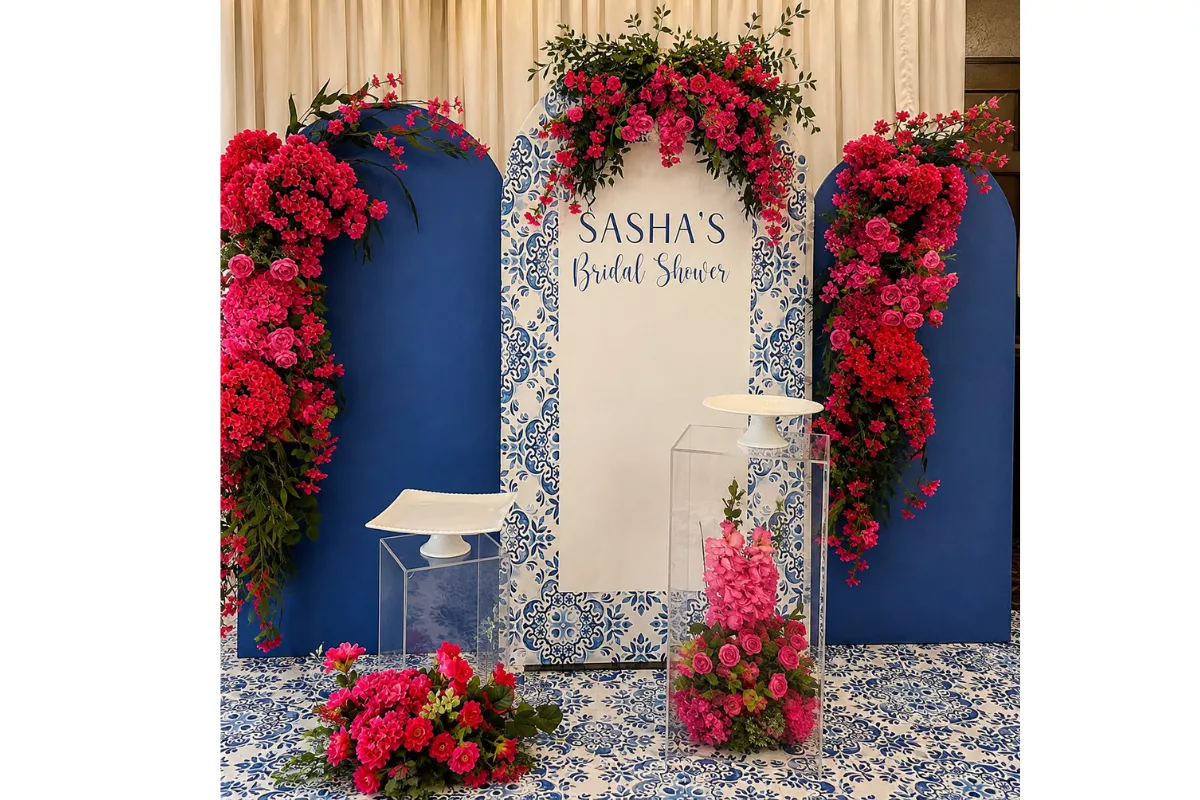
• Arched backdrops feel more focused. They can work beautifully behind a cake table, welcome display, or smaller photo spot without covering an entire wall.
• Layered arches or panels are another option if you want more depth. They give you room to add flowers, greenery, or signage without making everything depend on one flat background.
There is no one shape that is automatically better. Measure the space, think about what will sit in front of it, and make sure the backdrop is not going to overwhelm everything else.
Let the Sweetheart Table Be the Main Event
If your backdrop is going behind the sweetheart table, remember what people are supposed to notice first: the couple!
It sounds obvious, but it is easy for a reception setup to become so layered that the backdrop, flowers, candles, chairs, and table decor all start competing with one another.
If your table already has large florals, statement chairs, or lots of candlelight, the background can stay fairly simple. If the table itself is minimal, that is when a more detailed backdrop can do more of the work.
Scale matters too. A backdrop that is too narrow can disappear once the couple is seated. One that is much too large can make the table feel tiny.
Try looking at the whole setup as one picture rather than separate decor pieces. The backdrop should frame the moment, not steal it.
Make the Guest Photo Area Easy to Use
A photo area does not need a pile of props to be fun. In fact, simpler setups are often easier for guests to use.
Start with enough space. Two people may fit easily in front of a small backdrop, but things change quickly when four friends, long dresses, and a little extra enthusiasm enter the frame.
Leave room for guests to step back, move around, and take group photos without bumping into tables or other decor.
Placement matters just as much. A gorgeous photo backdrop hidden in a quiet corner may not get much attention. Put it somewhere guests already pass, such as near the cocktail area, bar, reception entrance, or another active part of the room.
Before everything is finalized, take one test photo. You may suddenly notice an exit sign, service door, speaker, or stack of venue equipment creeping into the frame.
Add Details, But Know When to Stop
Flowers, greenery, neon signs, initials, candles, and lighting can all make a backdrop feel more personal. They do not all need to be used at once.
If the backdrop already has a floral design or strong architectural details, a simple sign or a few flowers may be enough. A very clean background gives you more freedom to bring in fresh flowers, greenery, or a personalized sign.
Lighting deserves a little attention too, especially for an evening reception. The area should be bright enough that guests can see one another and take decent photos, but it does not need to feel like a photography studio.
If you are using candles, keep them safely away from fabric, flowers, and busy walkways.
Tie the Different Areas Together Without Matching Everything
Your sweetheart table, cake area, and photo backdrop do not need to look exactly the same. Actually, it is often better when they do not.
Instead of repeating the same design everywhere, choose a few details that can show up throughout the reception. Maybe it is the same soft pink used in the flowers and backdrop. Maybe you repeat an arch shape in the welcome display and sweetheart table. Maybe the same style of signage appears in two or three places.
Those small connections are usually enough. The room should feel coordinated, not copied and pasted.
And that is really the goal with reception backdrops. They should help define the spaces that matter, work with the venue, and make the room feel more finished without taking over the entire wedding.
If the backdrop looks like it belongs there once everything else is set up, you probably chose the right one.
This is a partnered post.